
What a Useful Internal Developer Platform Actually Standardizes
The platform is a contract, not a portal
An internal developer platform is useful when it removes repeated decisions without hiding the systems that make those decisions real. A service catalog, a deployment button, and a collection of templates may be parts of the platform. None of them is sufficient on its own. The platform has to define how software is created, owned, deployed, observed, secured, and retired.
This distinction matters because a polished portal can sit on top of inconsistent infrastructure. If every generated repository uses a different deployment model, identity scheme, or alerting convention, the portal has standardized the entry point and little else. The harder work is agreeing on the operational contract behind that entry point.
A sound platform contract answers practical questions. What must every production service expose? Which team owns it? How does workload identity reach a database or queue? Where are logs, metrics, traces, and deployment events found? How does a team request an exception? Which parts may teams change without waiting for the platform group?
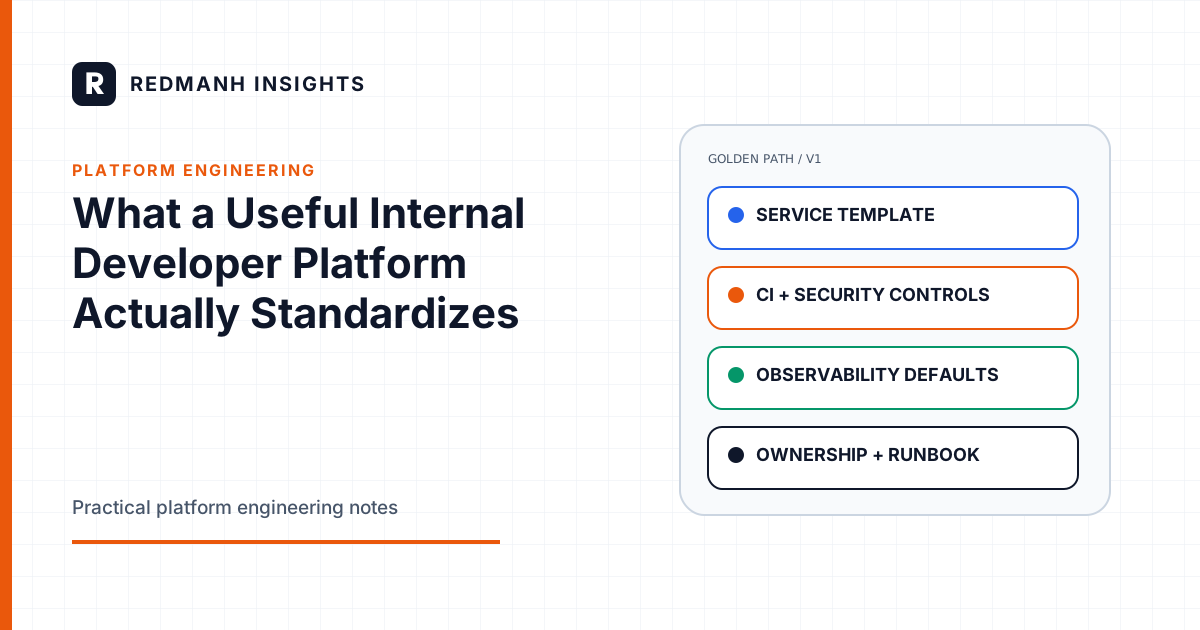
Golden paths should encode decisions, not conceal them
A golden path is the recommended way to deliver a common workload. It should cover a recognizable class such as an HTTP API, an asynchronous worker, or a scheduled job. It is not one universal architecture for every system.
The path should encode decisions that benefit from consistency: repository layout, build inputs, artifact publication, deployment promotion, workload identity, telemetry, ownership metadata, and rollback behavior. It should also expose the resulting resources. An engineer should be able to inspect the Kubernetes manifests, Terraform plan, IAM policy, pipeline steps, and service-level configuration that the path creates.
That inspectability separates a golden path from a black box. When an abstraction leaks during an incident, the team operating the service needs to understand the underlying system. A platform that withholds this information trades short setup time for slow diagnosis.
Golden paths also need explicit scope. A path for stateless request-response services may assume horizontal scaling and disposable instances. Those assumptions are unsafe for a stateful broker or a batch process with non-idempotent side effects. The catalog should state the workload properties each path supports and reject unsupported combinations early.
Paved roads permit variation
The paved road metaphor is more useful than the golden path when it emphasizes choice. The platform supplies a well-maintained route with known behavior, but a team may leave it when the workload requires something different. The cost of leaving should be visible rather than punitive.
A paved road normally includes supported versions, upgrade procedures, security patches, documentation, and a clear support boundary. A team that stays on it receives those benefits. A team that adopts a different runtime or deployment mechanism accepts specific responsibilities, such as vulnerability remediation, telemetry integration, and on-call documentation.
Platform teams should avoid turning recommendations into accidental mandates. If a path is mandatory because of a legal, security, or reliability requirement, name that requirement and enforce it with policy. If it is only the easiest supported option, call it a recommendation. Mixing these categories causes teams to route around the platform because they cannot tell which constraints are negotiable.
Service templates need a maintenance model
A service template is valuable only if generated services can receive later improvements. Copying a repository skeleton once creates a fork at birth. Six months later, its build actions, base image, policy files, and telemetry libraries may all be stale.
Prefer thin templates that reference versioned, centrally maintained components. A generated CI workflow can call a reusable workflow at a pinned version. A deployment package can consume a versioned Helm chart or module. Automated dependency updates can then propose controlled upgrades to service repositories.
name: service-ci
on:
  pull_request:
  push:
    branches: [main]

jobs:
  build-test-publish:
    uses: redmanh-platform/workflows/.github/workflows/service.yml@v3
    with:
      runtime: node20
      publish-image: ${{ github.ref == 'refs/heads/main' }}
    secrets: inherit
Pinning the reusable component makes changes reviewable. Floating references such as @main can alter every consumer without a service-level pull request. That may be convenient for urgent fixes, but it weakens reproducibility and expands the failure radius.
Template ownership also needs a policy. Record who reviews changes, which versions remain supported, how deprecations are announced, and how generated projects are tested. A template repository with no consumer tests is an example, not a product.
Ownership must be machine-readable
Ownership should not depend on remembering who created a repository. Store it in a system that both people and automation can query. The service catalog entry should identify an accountable team, escalation route, repository, runtime environment, data classification, dependencies, and operational tier.
Repository metadata can reinforce that record. A CODEOWNERS file controls review routing, while a catalog descriptor can bind the repository to an operational entity.
apiVersion: backstage.io/v1alpha1
kind: Component
metadata:
  name: orders-api
  annotations:
    github.com/project-slug: example/orders-api
spec:
  type: service
  lifecycle: production
  owner: group:commerce-platform
  system: ordering
  dependsOn:
    - resource:orders-database
The exact catalog product is less important than enforcement. A deployment pipeline can reject a production release when ownership is missing or points to an inactive group. It can also require a higher operational standard for a tier-one service than for an internal experiment.
Ownership is not the same as support. The platform team owns the platform contract and its shared components. The service team owns application behavior and its declared operational obligations. Make the boundary explicit so incidents do not become a negotiation over who should respond.
Observability should arrive with the workload
Every standard workload should emit a minimum useful telemetry set without custom integration work. That usually includes structured application logs, request rate, error rate, latency, saturation signals, trace context propagation, deployment annotations, and a stable service identifier.
The platform should standardize semantics before dashboards. A metric named request_duration_seconds is not comparable if one service records proxy latency and another records handler execution. Define where measurement starts and stops, how routes are normalized, which status classes count as errors, and which labels are prohibited because of cardinality or sensitive data.
Default alerts should detect service symptoms rather than every infrastructure fluctuation. A sustained error-budget burn or inability to process work is more actionable than a single CPU threshold. Infrastructure alerts still matter, but they should route to the team that can act on the underlying resource.
Telemetry also needs cost controls. Unbounded customer IDs in metric labels, verbose logs at steady state, and traces sampled without a policy can make the standard path expensive. The platform should supply safe defaults and show teams how to tune retention and sampling.
IAM is part of the developer interface
Identity and access management should be built into workload creation. Long-lived cloud keys in repository secrets are not a platform feature. Prefer workload identity that exchanges a short-lived runtime identity for narrowly scoped access.
On AWS, an EKS workload can use an IAM role associated with its service account. The role trust policy binds access to a named cluster identity, and the permission policy limits allowed actions and resources. Similar principles apply to OIDC federation from CI systems.
The platform should separate deployment identity from runtime identity. A pipeline may be allowed to update a deployment but should not automatically inherit the application's data-plane permissions. Likewise, a running service should not need permission to mutate its own infrastructure.
Teams need a readable way to request access. A pull request that declares a queue ARN and required actions is easier to review than a ticket asking for broad access. Policy checks can reject wildcards, unknown resources, and privilege escalation paths before changes reach production.
Escape hatches need engineering controls
An escape hatch is a supported process for departing from the standard path. It should capture the reason, owner, scope, risks, compensating controls, and review date. It should not require an executive exception for every unusual workload, nor should it become an undocumented bypass.
Some departures should be permanent because the platform does not cover the workload. Others should expire after a platform capability catches up. Record both categories. An exception inventory can reveal where the paved road is missing a common requirement.
Guardrails should focus on outcomes. A team using a different deployment tool may still be required to provide immutable artifacts, approval records, workload identity, telemetry, and rollback evidence. This approach preserves the operational contract while allowing implementation differences.
Measure whether the platform changes delivery
Portal visits and template counts describe activity, not value. Measurement should connect platform adoption to flow, reliability, and cognitive load without pretending that one number proves causation.
Useful operational measures include time from repository creation to a working non-production deployment, lead time for a reviewed production change, change failure rate, recovery time, percentage of services with valid ownership, age of supported component versions, and time required to complete common access changes. Segment the results by workload type and path version. Otherwise, a small static site and a regulated data service distort the same average.
Adoption should be measured per capability. A service may use the standard CI workflow but not the standard telemetry package. A single platform-adopted flag hides that difference and makes investment decisions harder.
Pair system measurements with short, task-specific research. Ask teams where they left the paved road, which steps required platform support, and which generated defaults they immediately changed. Then inspect the actual repositories and tickets. Survey sentiment alone cannot show whether a workflow became faster or safer.
The platform backlog should follow this evidence. Repeated exceptions indicate missing capability. Low adoption with strong outcomes elsewhere may show that the standard path is not competitive. High adoption with slow delivery may show that teams have little choice rather than a useful product.
Standardize the contract and keep the machinery visible
A useful internal developer platform standardizes recurring operational decisions. It gives teams supported routes, maintainable templates, explicit ownership, usable telemetry, least-privilege identity, and a controlled way to depart. It also lets engineers inspect what was created and understand who is responsible for it.
Start with one workload class and one complete contract. Test repository creation, deployment, rollback, access, diagnosis, upgrade, and retirement through the same route a service team will use. Expanding a proven path is safer than launching a broad catalog of shallow abstractions.
Need this built properly?
Redmanh LLC designs and operates Kubernetes platforms, Terraform managed infrastructure, and release pipelines for private and public sector teams.
Start a conversationRelated articles
Infrastructure as Code
A Safe Terraform State Migration Playbook
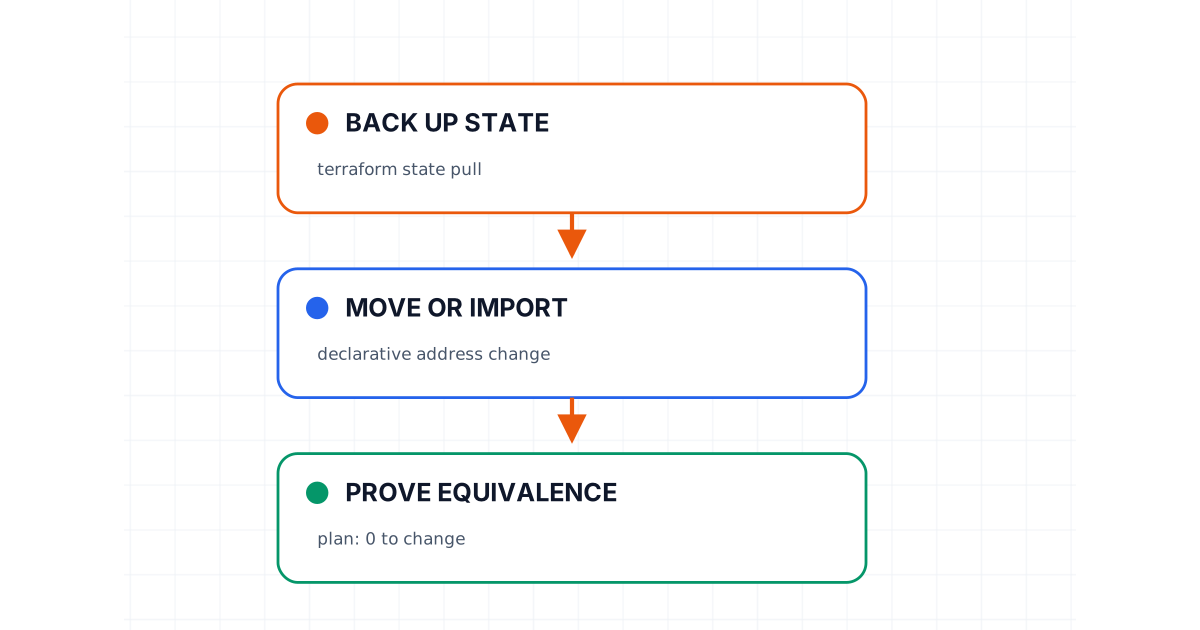
Move Terraform state without gambling on production: back up, verify locks, map addresses, prove plan equivalence, and preserve a tested rollback path.
8 min read
Kubernetes
Planning an EKS Upgrade Without Turning It Into an Incident
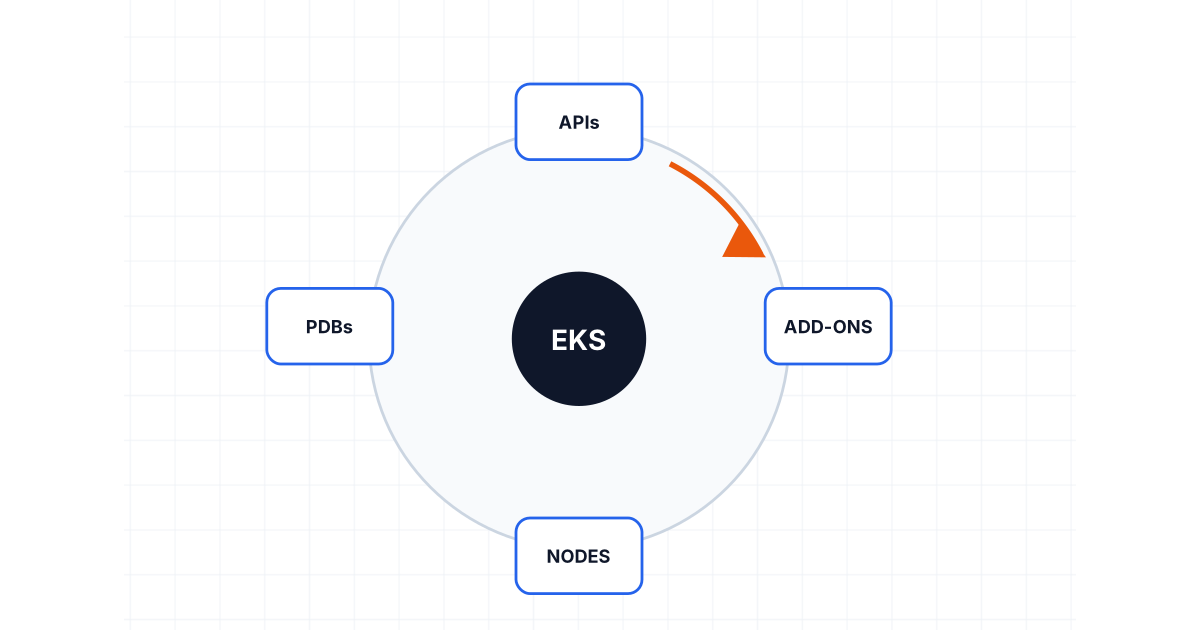
Upgrade EKS with explicit checks for skew, deprecated APIs, add-ons, disruption budgets, replacement nodes, canaries, observability, and rollback limits.
8 min read
Delivery Engineering
Rollback Is a Feature: Designing CI/CD Pipelines That Can Recover
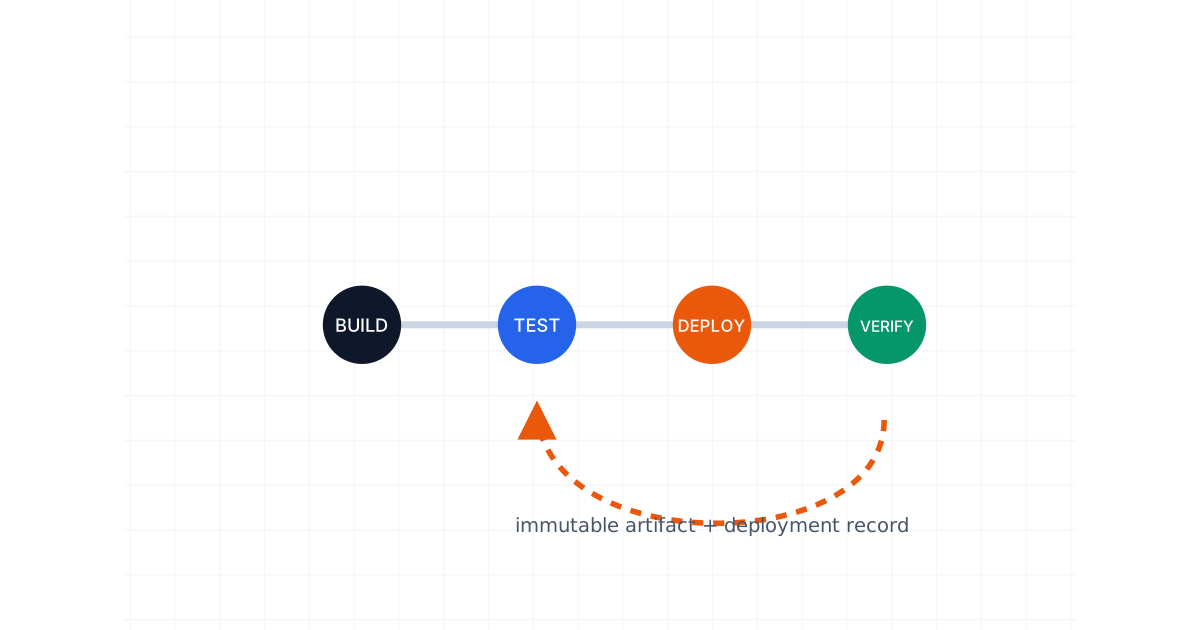
Build recovery into CI/CD with immutable artifacts, deployment records, compatible database changes, progressive delivery, flags, drills, and evidence.
8 min read